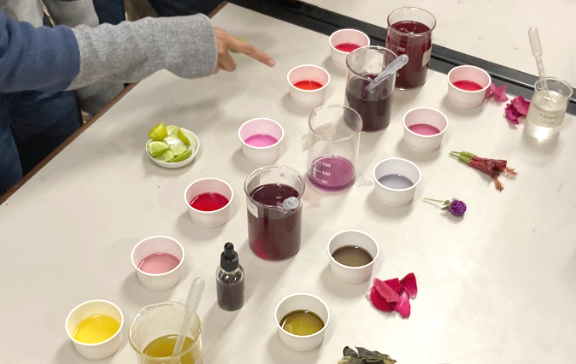
The year 2024 came with a variety of opportunities for me to shape my interest, work and research in natural colours into public engagement activities. This included one-day weekend workshops held for urban, city dwelling participants in Bengaluru, Karnataka. These were mellow experiences in making botanical inks from scratch, lasting 3-4 hours, by working with everyday kitchen and garden scraps (like onion peels, marigold flowers, fruit peels) to extract colours from. Another form of engagement was of academic workshops that spanned five to ten days, at institutes of higher education. I designed these sessions such that the class was either provided the natural sources of colours in the studio to extract colours from (the five-day course) or was taken out to sites like flower and vegetable markets, allowing the students to pick and gather the natural sources on their own (the ten-day version). In this blog, I’ve shared an overview of the most recent academic assignment that I undertook in December 2024, at CEPT University, Ahmedabad, Gujarat.
It was in 2023 that I began with the five-day academic workshop upon an invitation from the CARE School of Architecture in Trichy, Tamil Nadu for their summer electives. In that workshop, I introduced the participating students to some processes of extracting colours from given natural sources followed by assignments to try out the processes themselves, apply them to paper and other substrates. This format gave the participants just about enough time to appreciate the effort it takes to make one’s own colours from scratch. I called it ‘Pandemic Dyes’, naming it after my experience of beginning my natural colour experiments during the COVID-19 lockdowns. After offering this workshop at CARE twice in 2023-24, I got to conduct a similar workshop during the June 2024 Summer Winter School (SWS) at CEPT University as well. Following the success of all of these experiences, I decided to offer an extended ten-day course for CEPT’s December 2024 SWS programme.
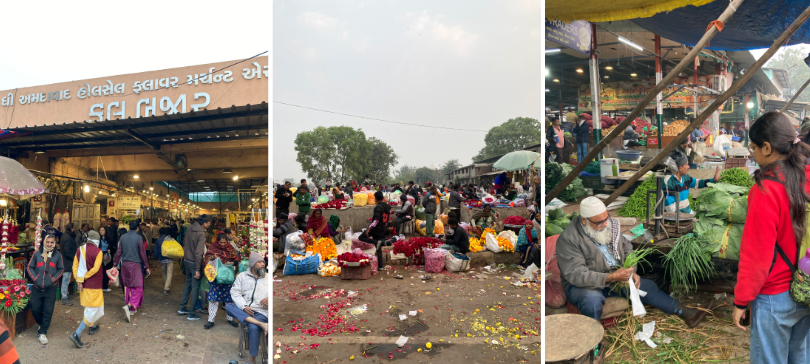
This workshop in December 2024, titled ‘City as the Colour Lab: Ahmedabad’ came with two benefits—the cooler winter months in Ahmedabad allowed for an ease in making site visits, and the longer duration allowed me to set assignments focused on a colour-first approach in visual interpretation. For the site visits, I first took the students to the bustling wholesale flower market in Jamalpur, then to the wholesale fruit & vegetable market in Kalupur, and finally allowed them to choose a third location of their liking. During these visits, I provided the students with some fundamental guidance on what they could collect and how they could discern a natural source’s potential to give colour. Following that I left them to walk around, observe the characteristics of the space, make sketches, talk to the vendors and decide on what they could either collect from scraps or buy fresh to make the colours with.
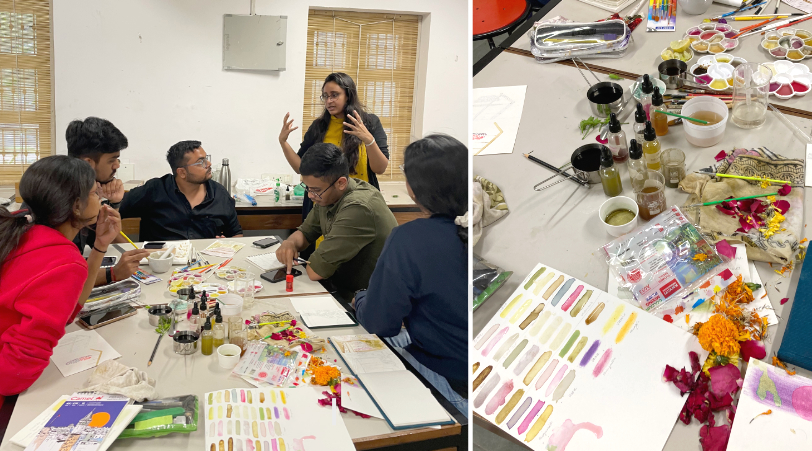
Next, we gathered in the studio after each site visit, took stock of the materials collected and proceeded to make the colours. I taught the students ways to use an aqueous and an alcohol medium to extract the chromophores from whichever botanical source they decided to work with, and encouraged them to create a colour palette from all the fruit/vegetable peels, flowers and leaves collected. To encapsulate their experiments and learnings into a visual form, I gave them exercises in creating artworks using their colour palette. These exercises involved the students using their on-site observations and sketches to visualise the essence of the site, with the colours from the site itself being a key composition-making element. During all this, the students worked in groups, learning from each other both while at site and in the studio. Effectively, this extended format gave the students an opportunity to delve into the particularities of nature, chemistry, culture and visual language—through colour.
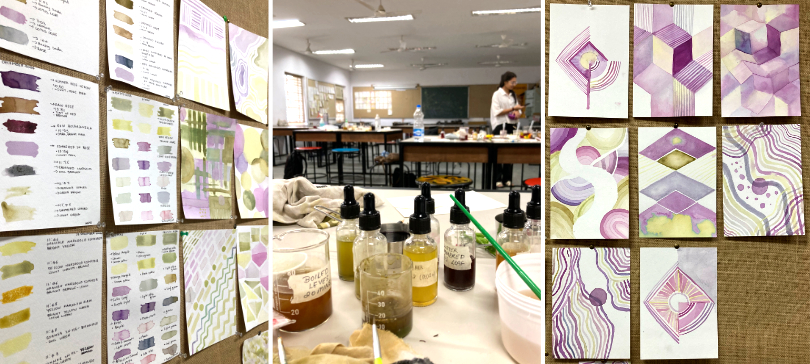
When I began my weekend experiments in brewing colours from kitchen scraps during the COVID-19 lockdowns, it was with the intent of keeping in touch with certain things in everyday life that I felt truly mattered—making art, being amidst nature, maintaining healthy food habits—particularly in the middle of a global health crisis. Back then, conducting academic workshops was not an outcome that I had envisioned. Yet, these workshops have developed to become an integral part of my art practice. As I have taken on these teaching assignments, based primarily in working with nature and people, it is becoming more evident that there is a very real need to take up activities (academic or otherwise) that allow us a few hours or even days of disengaging from the digitally saturated world we currently live in. Towards that, taking a walk, smelling some flowers and making colours certainly help.

All images are by the author, and Hridi Shah.
This workshop was made possible with the support of faculty members and administrative staff at the Faculty of Design in coordination with the SWS team at CEPT University. Working with the sharp and witty students at CEPT made for a truly engaging and educative experience for me. Having friends and advisors like Priyanka Baliyan, Ar Maniyarasan R, and Ar Priyanka Kanhare make the endeavours of an independent designer like me seem less arduous.
Details of the two Summer Winter School sessions can be found in the SWS archives (links below).
Summer session: https://sws.cept.ac.in/archive-course-detail/2024/S/botanical-colours-lab-S24FD004
Winter session: https://sws.cept.ac.in/archive-course-detail/2024/W/city-as-a-colour-lab-ahmedabad-W24FD001
 Pans & Spaces
Leave a comment